




Cutting MarTech Bloat: Choosing the Right Tool for the Right Purpose
Published: February 01, 2024 | Updated: July 21, 2025
Introduction
MarTech bloat is the accumulation of marketing technology tools within a company's ecosystem, leading to operational inefficiencies and diminished returns on investment.
As organizations grow and change, they purpose several software and hardware solutions for analytics, automation, and customer engagement. They have trouble integrating these tools with each other, and with legacy system configurations.
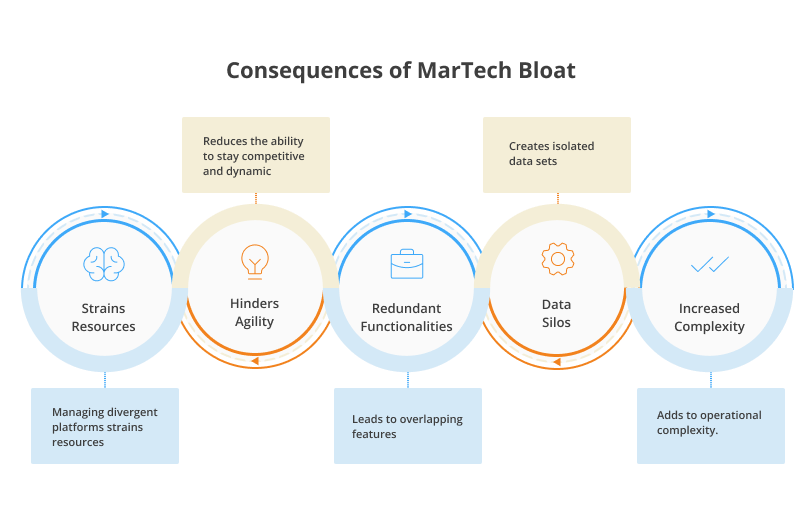
Managing divergent platforms strains resources and hinders the agile adaptability required to stay competitive and dynamic. MarTech bloat results in redundant functionalities, data silos, and increased operational complexity. It impedes extracting valuable insights and executing cohesive campaigns.
Managing MarTech bloat is about balancing growth, innovation, simplification, and efficiency, in pursuing optimal expected performance.
Download Your [Free Guide] Now for a Successful MarTech Migration Journey!
MarTech Bloat is organic
Market bloat creeps on even the most watchful of businesses. Over time, technology ecosystems that power all business processes become less efficient. This is how it happens. And the panacea to all MarTech bloat is MarTech Optimization.
Degrees of personalization change: The level of personalization desired has grown from impersonal to customer-centric. From simple demographic targeting to batch personalization, real-time responses, and now hyper-personalization driven by machine learning and artificial intelligence.
MarTech platforms have also had to develop these capabilities in response to changing consumer behavior, competition, and global brand standards.
New communication channels emerge: Consumer behavior is inconstant, influenced by emerging trends and preferences. Flyers, posters, letters became emails. Telephone, TV, and radio are now smartphones. News and print ads are now websites, and organic and paid ads for optimized search engines.
New channels to communicate with audiences are constantly being created and populated. Since campaigns want to reach people where they spend their time, campaign MarTech needed to adapt to send and track messages on these new channels.
Developing businesses take snap MarTech decisions: Businesses grow and change. So do marketing goals, thrusts, and strategies, in response to new use-cases. These are good problems to have.
Bloat occurs when businesses add new tools to address immediate needs on-the-go, without a clear and cohesive long-term MarTech plan. These are typically out-of-the-box by-the-book installations that do not exploit the tool’s full promise. Neither are the tools aligned to your unique marketing workflows and processes, or marketing vision.
Over time, enterprises end up accumulating incompatible tools from multiple, often competing vendors. Such tools function in silos. They resist the integration to boost marketing efficiency.
Incompatible Tools: Eventually, the MarTech toolkit becomes bloated - cluttered with redundant, overlapping, and conflicting software.
In these situations, integrating different tools and data sources is a constant challenge. Budgets, costs, and disruptions in business operations often limit these efforts. And more often, limited by a lack of clear vision regarding objectives, costs, and benefits.
Marketing platforms evolve: In the early days, marketing platforms had specific proficiencies. Over time, they have become like Swiss blade knives. Now, they can do almost everything, building in extensive redundancy.
Still, they have some core functions, and other peripheral ones. Your stack struggles to scale if you use peripheral tools for main tasks, and vice versa. The result is MarTech bloat.
Tools Evolve: MarTech tools are built to convert marketing objectives into actionable tasks. Developers regularly release updates, upgrades, patches, security improvements, and versions.
These changes subtly or significantly alter how the tool functions. In an already discordant system, such updates might not necessarily lead to added efficiency in the context of the existing stack and scheduled campaigns. It is equally possible that the inconsistencies widen, leading to furthering MarTech bloat.
Technology itself evolves: From simple email programs and impersonalized mass marketing, MarTech has grown to support automated, AI enhanced, data-driven hyper-personalized, customer-centric approaches. New platforms are regularly being developed that are more efficient, with better features and global scalability. Often, the benefits of replacing existing tools with these new ones outweigh the costs of buying and implementing them.
Data Integrity and Security requirements change: Unlike even a decade ago, businesses increasingly rely on data-driven insights. Generic or legacy MarTech data systems will fail to safeguard against potential breaches, unauthorized access, and virus attacks that threaten the accuracy and confidentiality of sensitive customer information. Considering the consequences of such breaches on customer trust, such data systems are redundant in the current context, adding to bloat.
These factors make the MarTech stack a smorgasbord of assorted tools and platforms that impede marketing performance. The only way to keep the MarTech stack aligned with marketing objectives and processes is to continually manage it.
MarTech Optimization- Panacea to Cure MarTech Bloat.
To counteract MarTech bloat, businesses must optimize their MarTech stack by aligning it with brand objectives, adopting a streamlined purchasing approach, and implementing a systematic stack management methodology.
Adapt to consumers: An optimized MarTech stack adapts to shifts in online consumer behavior and preferences, allowing for more refined targeting and personalized messaging. This translates to higher engagement rates, as campaigns resonate more effectively with the intended audience.
Identify the right tools: Only MarTech optimization can identify if core tools perform the important marketing functions. The process will identify, purpose, and align the best tools for each job in the context of the marketing vision, and operational workflows.
Allow for Scale: An optimized MarTech stack is built to scale, accommodating increased workloads and complexities. Flexibility within the system provides the space for integrating new tools or platforms, empowering businesses to adapt to changing market conditions.
Secure Data: Data security and integrity are not just a regulatory imperative. They are strategically essential. Periodic MarTech optimization institutes robust encryption, authentication protocols, and regular audit of data collection processes, storage protocols, and compliance measures. By maintaining stringent data integrity, businesses build trust with their audience and mitigate potential regulatory risks.
The MarTech Stack Optimization life cycle:
Identify gaps between business needs and performance of the existing stack, and the best fit tools to bridge this gap.
Implement identified and configured solutions.
Integrate implemented solutions to work smoothly with the existing technology eco-system.
Maintain the eco-system with technical support for business, application updates and upgrades, fixes and workarounds, and data migration.
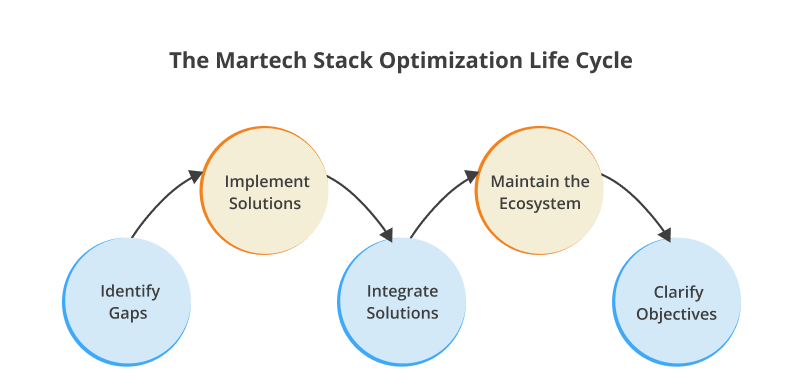
Clarify Objectives: The process of MarTech Optimization enforces a template for defining marketing objectives and goals and brings clarity. The process then evaluates the stack for its ability to meet these objectives, identifies and eliminates inefficiencies, and reduces unnecessary expenses. By streamlining operations, businesses can allocate resources more effectively, optimizing their ROI.
Spot the Gaps: At its core, MarTech Management optimizes inadequacies in meeting predefined performance objectives. Spot the gaps between existing MarTech capabilities and what’s required to power the velocity and scope required to meet the marketing objectives.
Identify tools that are underutilized or duplicative, as they can lead to inefficiencies and unnecessary costs. Find sub-optimal tools, conflicting workflows, hard to access data sources, and outdated platforms.
Check if sub optimal tools run critical functions. If tool redundancies clog up workflows, and impact campaign throughput. Check if new technology has been purchased ad hoc, as an instant fix. Check for larger incompatibilities of each new tool to others, and to the stack. Spot the imminent slippages.
Consider factors like user adoption, integration capabilities, and ROI to determine which technologies align best with the marketing objectives, and which do not.
A Systematic Procurement Approach
This approach becomes relevant when it is determined that gaps exist between the ideal MarTech configuration and the optimized existing stack. And that these gaps can only be filled by procuring new platforms and tools.
Succinctly, the steps to be followed in identifying and procuring the precise tools are:
Needs Analysis.
Discover state, usage, and utilization of installed MarTech.
Compare alternate platforms for best-fit and budget.
Short-list platforms.
Identify modules to align the optimal tool for each core marketing function.
Negotiate business, application support, and versioning terms.
Make a purchase recommendation.
Be vigilant when selecting MarTech platforms. Not only should they be the best option within a budget to do the job, but also consider factors like vendor pedigree, scale and period of support, integration with other platforms, etc.
What you decide to go with here will have future repercussions and needs to stand the test of time.
Final Thoughts
If Chief MarTech Officers wish to harness the full potential of their MarTech stack, MarTech leaders and their technology owners must stay abreast of technological advancements, refine targeting strategies, maximize cost efficiency, ensure data integrity, and enable scalability.
They need deep insights into the modules that excel, and those that don’t. And also, of the platform dependencies that create an efficient whole.
Periodic MarTech optimization is the linchpin for marketing success. Technology Leaders who commit to MarTech Management and Optimization not only keep marketing operations relevant and effective, but also position businesses for sustained growth and competitive advantage.



Global Office Locations

2570 N. First Street, Suite 200,
San Jose, CA 95131

Office No. 26, 10/F, Beverley Commercial Centre,
87-105 Chatham Road South, Tsim Sha Tsui, Kowloon,
Hong Kong

The Octagon Building, #11-07, 105, Cecil Street,
Singapore 069 534

#901, 9th Floor , Ellora Fiesta.
Plot No - 8 , Sector - 11 , Sanpada.
Opp. Juinagar Rly Station.
Navi Mumbai – 400 705

Xerago Towers, Plot 80 & 93,
Industrial Estate, Perungudi,
Chennai, Tamil Nadu - 600096





(Coming Soon)
2570 N. First Street, Suite 200,
San Jose, CA 95131
Office No. 26, 10/F, Beverley Commercial Centre,
87-105 Chatham Road South,
Tsim Sha Tsui, Kowloon,
Hong Kong
The Octagon Building, #11-07, 105, Cecil Street,
Singapore 069 534
#901, 9th Floor , Ellora Fiesta.
Plot No - 8 , Sector - 11 , Sanpada.
Opp. Juinagar Rly Station.
Navi Mumbai – 400 705
Xerago Towers, Plot 80 & 93,
Industrial Estate, Perungudi,
Chennai, Tamil Nadu - 600096
(Coming Soon)